
Our member, Pam W., recently attended the presentation by the League of Women Voters of East Alabama (LWVEA) and this is her recap:
Restoring the Vote: How LWV Lee County Helps Felons Reclaim Their Voting Rights
I attended the League of Women Voters of East Alabama (LWVEA) regular monthly meeting on Monday, September 13, 2026. Harriette Huggins, an LWVEA member and Lee County representative for the League of Women Voters of Alabama (LWVAL) Education Fund’s Restore Alabama restorative voting rights initiative, led the discussion.
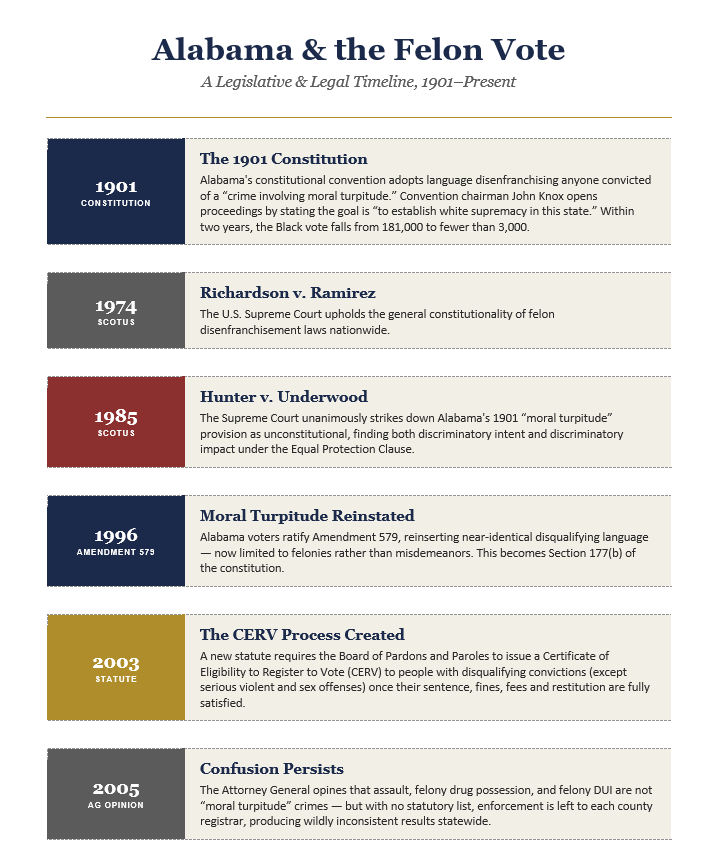
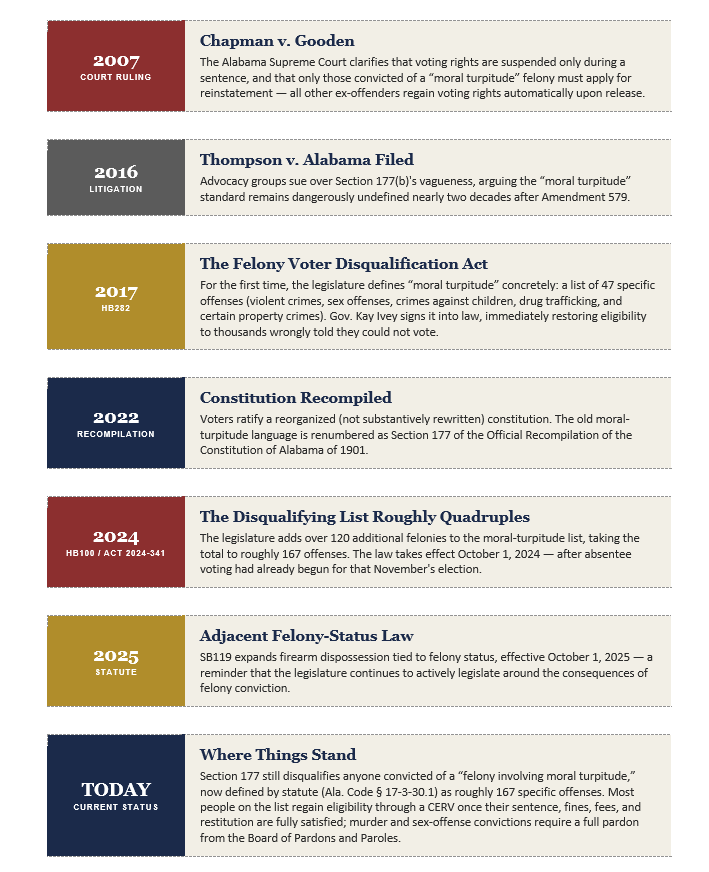
Harriette began with a brief history of felony disenfranchisement in Alabama. I compiled and reviewed an AI-generated historical outline of what has happened since 1901 regarding the disenfranchisement of those convicted of felonies (see below). It is always interesting to see how the Alabama legislature has continued, over more than a century, to find new ways to keep citizens from voting. The state remains one of a handful of states where it is very difficult for those with criminal convictions to vote unless they obtain approval from the government.
Restore Alabama
None of this has stopped LWVAL from collaborating with other groups, including Campaign Legal Center, to help restore people’s right to vote. In 2020, under former LWVAL President Kathy Jones, the Alabama state League launched Restore Alabama, a program that offers free, confidential help to individuals with felony convictions to determine eligibility and restore their voting rights. At that time, it was estimated that about 200,000 Alabamians would need assistance. Today, Harriette and a small team continue that work, maintaining a list of individuals who are eligible to restore their voting rights. From 2026 alone, the group has a list of about 900 Alabamians they are working to assist. Team members contact individuals via text to offer assistance. When someone replies, they help them through the process by helping them complete a Certificate of Eligibility to Register to Vote (CERV) form and ensuring that process requirements are met.
How It Works
To restore their voting rights, a person must meet the following requirements: they have no pending criminal charges; have paid all fines, fees, and restitution ordered at the time of sentencing; and they have completed either the full sentence, probation/parole, or been pardoned. Once these requirements are met, they may apply for a CERV. Once the CERV arrives in the mail, they can take a copy to their local registrar’s office and register to vote. This information is laid out on a handout, “I Have a Felony Conviction, What Are My Voting Rights in Alabama?”, which was available at the meeting.
It’s also worth noting: anyone whose felony conviction isn’t listed on the handout, or whose conviction is a misdemeanor, can register and vote right now.
Harriette said the number of replies has been small, but there have been some wonderful success stories — especially the times she’s helped someone apply for a pardon and complete a CERV application. The process takes about 44 days (or longer if there are outstanding fees associated with the conviction) but it’s worth it to secure someone’s right to vote.
More Volunteers Are Needed
The team is looking for more members in Lee County. Each team member is given a list of about 20 names to contact. It’s a monthly commitment, but a worthwhile one — many people on these lists have no idea they have the right to request their voting rights back, let alone the right to vote itself.
One note on timing: Alabama’s voter registration deadline for the next election is October 19. Anyone contacted now won’t be able to register in time for that election, but the hope is to start the conversation and get the process moving for whoever is interested, so they’re ready for future elections. Too many people believe their vote doesn’t matter. We know it does.
How Can I Get Involved?
If you’re interested in joining the effort, sign up here. If you have questions, please email the League of Women Voters of East Alabama at lwveastal@gmail.com.
Sources
Hunter v. Underwood, 471 U.S. 222 (1985); Richardson v. Ramirez, 418 U.S. 24 (1974); Chapman v. Gooden, 974 So. 2d 972 (Ala. 2007)
Ala. Const. Art. VIII § 177 (Official Recompilation of 1901, as amended); Ala. Code § 17-3-30.1 (Felony Voter Disqualification Act, HB282 (2017); HB100 / Act 2024-341)
ACLU of Alabama; Campaign Legal Center; Southern Poverty Law Center; Collateral Consequences Resource Center; Encyclopedia of Alabama; Harvard Law Review, “Thompson v. Alabama” (2023)